How to Run a Printable Christmas Escape Room for Kids at Home
A Christmas escape room is one of the best things you can do with kids in December. It turns an ordinary afternoon into a mission: Santa's sleigh is locked, the elves have lost the code, and the kids have 45 minutes to save Christmas. They solve puzzles, find hidden clues and work as a team, and they'll be asking to do it again the next day.
You don't need padlocks, a big house or a weekend of prep. Here's how to run a printable Christmas escape room at home, at a party or in a classroom, for children aged about 6 to 12.
How a kids' escape room works
Kids get a story with a goal ("unlock Santa's workshop before midnight") and a series of puzzles. Each puzzle gives a code, a word or a location. The answer to one puzzle leads to the next. The final answer opens the "lock", which can be a real padlock, a locked box, an envelope or simply you saying "Correct!".
The magic is in the chain: kids feel like detectives because every answer unlocks something new.
Step 1: Choose a story
Keep it short and give it stakes kids care about. Ideas:
- Santa's sleigh won't start. The elves have to find the five-digit code before take-off.
- The Grinch locked the presents away. Solve his puzzles to get them back.
- The reindeer have escaped. Follow the clues to find where each one is hiding.
- The North Pole's recipe for hot chocolate has been stolen. Find it before the elves go on strike.
Read the story out loud at the start, or record a short "message from Santa" on your phone and play it.
Step 2: Pick 4–6 puzzles
For ages 6 to 8, four puzzles is plenty. For ages 9 to 12, five or six. Mix types so different kids get to shine.
Puzzle ideas that work with printables
- Word search with a hidden message. The leftover letters spell the next location ("look under the tree").
- Maze. The path passes through numbers; reading them in order gives a code.
- Secret code or cipher. A simple symbol or number alphabet (A=1, B=2) decodes a message.
- Jigsaw. Print a picture with a code on the back, cut it into 8 to 12 pieces and hide them.
- Sudoku or logic grid. A 4×4 sudoku for younger kids; the numbers in the shaded squares form the code.
- Spot the difference. The number of differences is one digit of the final code.
- Colour by number. Once coloured, the picture reveals a number or a word.
- Hidden objects. Small paper ornaments hidden around the room, each with a letter on the back.
Puzzles that don't need printing
- Count the baubles on the tree (or on one side of it).
- Song clue: "The answer is the number of drummers drumming" (twelve).
- Torch hunt: turn the lights off and hide clues that can only be found with a torch.
- Ice puzzle: freeze a small toy or a clue in a plastic tub. Kids have to melt it out.
Step 3: Build the chain
Write your puzzles on a piece of paper in order, with the answer to each one and where it leads. For example:
- Story letter says "Start at the word search."
- Word search leftover letters spell "FRIDGE".
- On the fridge: a maze. The path spells the number 4.
- A cipher decodes to "LOOK INSIDE THE BOOT BY THE DOOR".
- In the boot: jigsaw pieces. The back reads 7, 2.
- Final code: 4, 7, 2 opens the box with the treat (or the "sleigh key").
Test it yourself, or with an adult, the day before. Every escape room has at least one clue that makes sense only to the person who wrote it.
Step 4: Set up the room (30 minutes)
- Hide clues at kid height and in places they can reach safely. Nothing on high shelves, near the oven or behind fragile things.
- Mark "off limits" areas with a sticky note or tape so kids don't tear apart the whole house.
- Use envelopes numbered 1 to 6. Kids can't open envelope 3 until they've solved puzzle 2. This keeps the order clear for younger kids.
- Put the final prize in a box with a padlock, a combination lock, or tied with ribbon and a "do not open" label.
- Set a timer where everyone can see it. 45 minutes works for most groups; 30 for younger kids.
Step 5: Run the game
- Read the story with energy. Costumes help: a Santa hat or elf ears for the game master.
- Start the timer.
- Give hints when needed. Hand each team three "hint cards" (a candy cane or a paper snowflake works) they can trade for a hint. Kids love having control over when to use them.
- Encourage teamwork. If one child is solving everything, give a quieter child the next envelope to open.
- Celebrate the escape. When the final lock opens, make a big deal of it: a cheer, a certificate, a treat.
How long should a kids' escape room take?
- Ages 5 to 7: 20 to 30 minutes, three or four simple puzzles, lots of help.
- Ages 8 to 10: 30 to 45 minutes, four or five puzzles.
- Ages 11 to 13: 45 to 60 minutes, five or six puzzles, fewer hints.
It's better to finish with time to spare than to run out. If the kids are stuck and the clock is ticking, give a bigger hint. Escaping is the point.
Running it for a group or a class
- Teams of 3 to 5. Bigger teams leave kids standing around.
- Copy every puzzle once per team and use different colours of envelope for each team.
- Race or play together. In a class, teams can race against each other, or all teams can work on the same final code, each solving one digit.
- Give older kids the hard puzzles. Mixed ages work best when older kids are paired with younger ones and told to help, not take over.
Make it a full Christmas afternoon
An escape room fits nicely into a bigger plan. Some ideas:
- Escape room (45 minutes).
- Hot chocolate break.
- Christmas bingo or a colouring session while everyone calms down.
- A Christmas film.
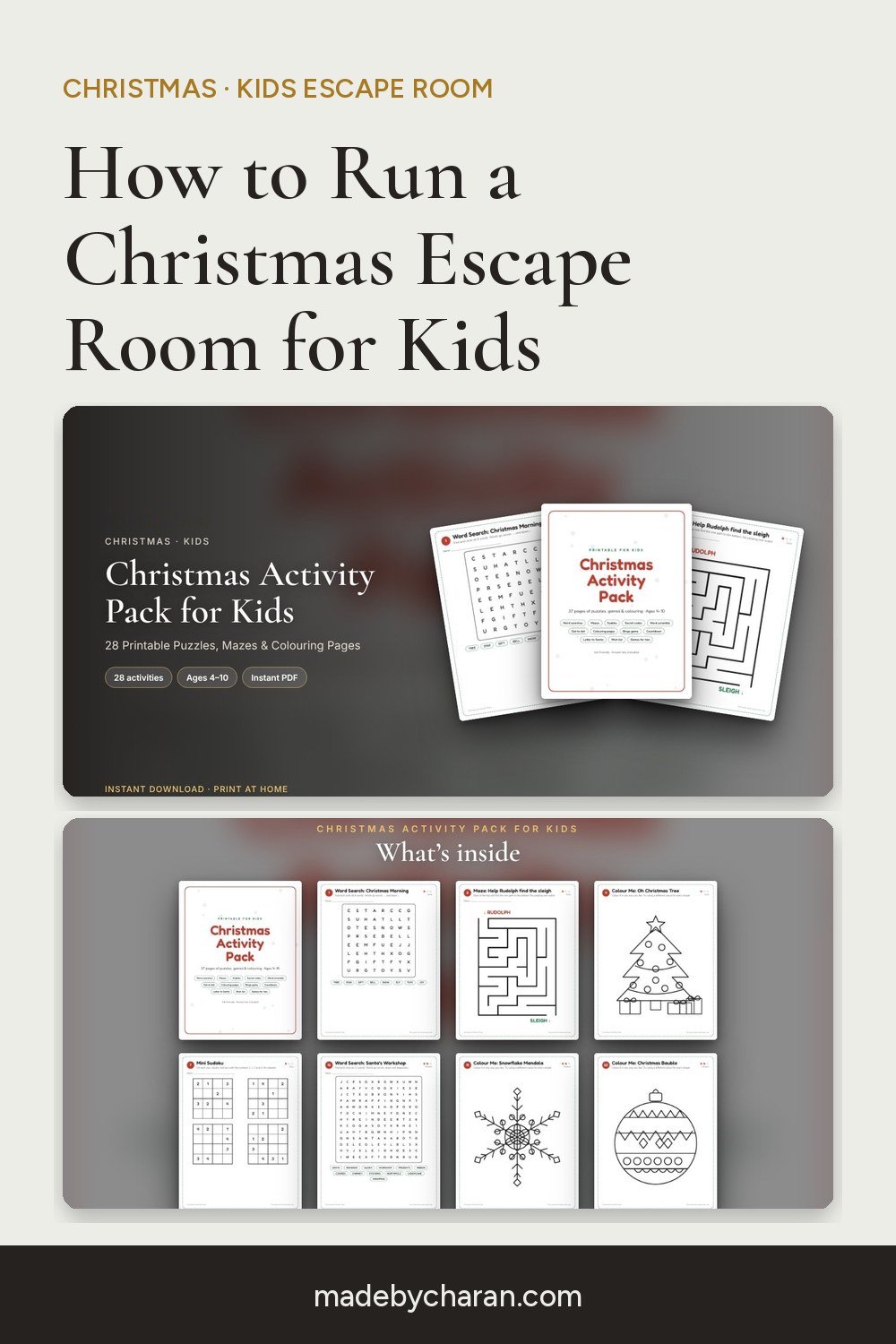
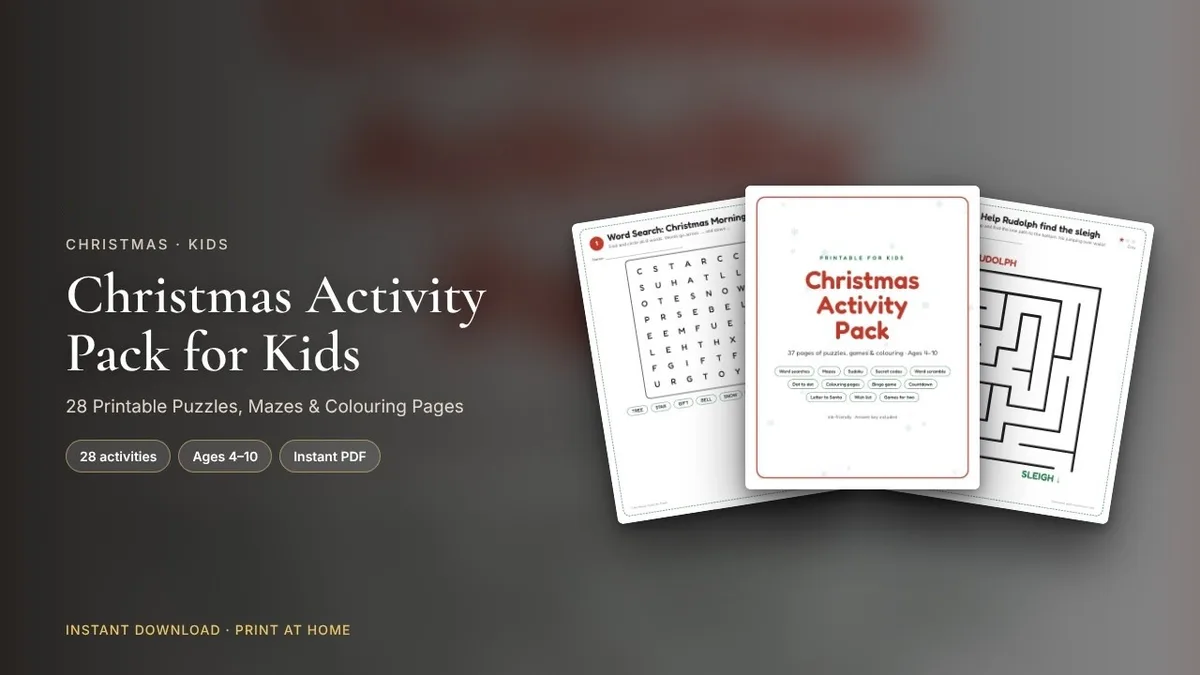
Our Christmas Activity Pack for Kids is handy here. It has word searches, mazes, a secret code puzzle, an elf code, mini sudoku, dot-to-dots, colouring pages and Christmas bingo for ages 4 to 10. Many of the pages work as escape room puzzles: the maze, secret code, word search and sudoku slot straight into the chain above, and the answers are included, which saves you checking them yourself. It prints on US Letter or A4.
Looking for something that runs itself? The Case of the Missing Sleigh Bells is a printable Christmas mystery for kids aged 8+ and 8 to 12 players. Santa's golden sleigh bells have vanished, and the elves have until six o'clock to find out who took them. It's a detective game, not an escape room, but it uses the same mix of clues, teamwork and a big reveal, with no murder and nothing scary. A full host guide is included.
For a quick taste with no printing at all, play one of our free mystery games on a phone or tablet together.
FAQ
What age is a Christmas escape room good for?
From about 6 with simple picture puzzles and an adult helping, up to 12 and beyond with ciphers and logic puzzles.
Do I need real padlocks?
No. Numbered envelopes, a ribbon-tied box or an adult who checks the final code all work. A cheap combination lock does add excitement, though.
How many puzzles do I need?
Four for younger kids, five or six for older ones. Each should take 5 to 10 minutes.
Can kids play a printable escape room on their own?
Older kids can, if an adult sets it up and holds the answers. Younger kids need a game master to read clues and give hints.
How do I make an escape room for a big group of kids?
Split them into teams of three to five, give each team its own copy of every puzzle, and either race or let every team solve one part of the final code.
A good Christmas escape room isn't about difficult puzzles. It's about the moment the box opens and a room full of kids cheers like they've just saved Christmas. Because, as far as they're concerned, they have.